

Vadim Gershteyn, PhD, MPH served as my editor for StressHacked and contributed writing to The Stone Wall. He joins me for this discussion.
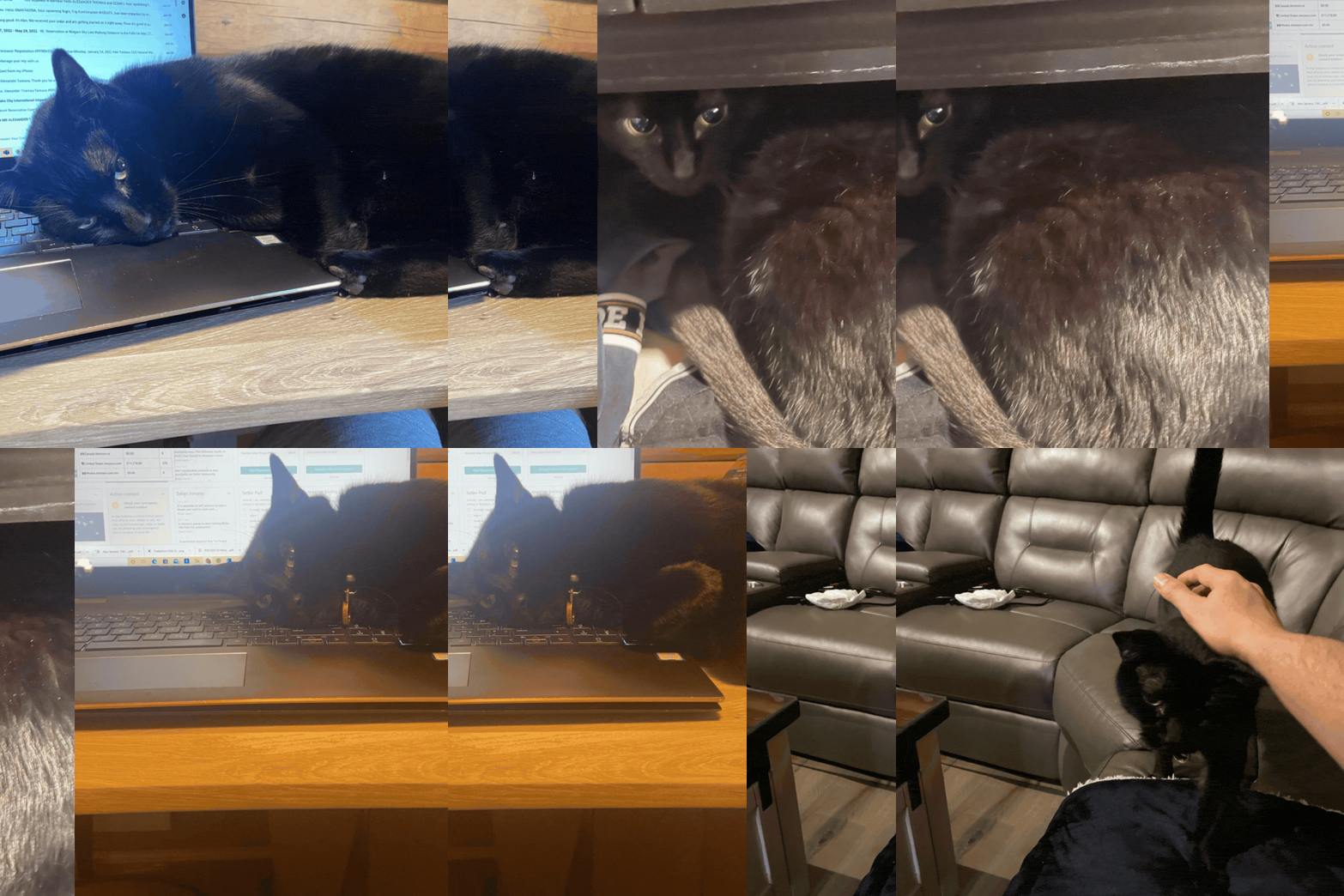
AT: My cat, perhaps my best friend, died. It wasn’t expected, although he was aging. I adopted him from the shelter over a decade ago, and he was “3-5 years old” at that time. “Officially,” he was ~15, but he could have easily been 17. Before our move to the USA, the vet checked him and said he was in exceptional health for a cat of his age. Good teeth, solid muscle mass.
After the move, he began having accidents in our new home. I took him to the vet, his blood was tested and he received a “physical,” and I was told the same as the previous vet—our little buddy was in exceptional health, albeit he’d lost 2 pounds. The vet chalked it up to stress, prescribed him some meds, and sent us on our merry way.
He continued to deteriorate, sleeping more, eating less, and visually losing weight. We called the vet, he recommended a cat specialist with imaging, so that’s what I did. That visit was a hard one. Before the vet took him back for imaging, she relayed that she felt a hard lump in his stomach. She suspected stomach cancer, rapid growth considering the last two vets had missed it and it was now “obvious.” Imaging confirmed and she explained how the nature of the growth ruled out any sort of constipation or obstruction. He had lost another 4 pounds, dropping from a formidable 17 pounds to a shadow of himself, only 11 pounds a few months later.
The vet told me my cat had, by her estimate, less than two weeks to live. She prescribed him anti-nausea pills, and prednisone. After starting these meds, my cat began eating again, doubling his intake and perhaps even gaining some weight back. A week and a half after the diagnosis, he caught a mouse. He certainly had the will to keep going.
The problem was, he was gorging himself, then sitting in obvious pain before getting sick. I contacted the vet, and she strongly pressured me, or rather attempted to, euthanize him that day. I pushed back, he was eating, had just hunted, and was seeking cuddles and attention. He was waking me up to get his breakfast. He wanted to live. The vet attempted to moralize me, stating he was “in pain,” and the “humane” thing to do was to put him out of his misery. I pushed back that we are “all in pain, life is pain, should we all end it here and now?” I then asked her if the pain we are worried about is what is afflicting our pets, or our own emotional pain in watching death creep in.
She paused, didn’t respond, and then had me repeat some facts about his behavior, such as the caught mouse, the cuddling, and the demands for breakfast, with accompanying prance to his food, tail up, when I finally answered his call. She asked me how often he seems to struggle, I repeated “only after he gorges himself.”
She countered and offered opioids. They’d potentially curb his appetite to help him regulate, and cut the pain. She advised they “may not work,” and to “plan for end of life.” Of course, opioids will not “work,” in the sense of curing his cancer. She meant, I presume, easing his pain. They certainly seemed to do the latter, and he thoroughly enjoyed them. On the third day of his dosing, he awoke himself to “demand” his drugs, sitting patiently as I opened his mouth to squirt them in. He also, post drugs, began sleeping next to me every night, a practice he’d stopped the month leading up to his diagnosis. He was given less than two weeks to live; he endured for 8 weeks and 5 days, finally passing September 25th, 2026.
The conversation with the vet, and my own emotions during the ordeal, led me to ask two questions:
We often care more about our pets than our closest loved ones. Often, our pets are held more dearly to us than our friends and extended families, and in some cases (after traumatizing), pets are loved more than is shown to our immediate family. Why?
If we care about our pets to this extent, why do we allow ourselves to have them euthanized? Allow the veterinary clinic to dispose of their bodies like trash, a fate we would almost never allow happen to even our more distant friends.
It dawned on me that the second question partially answers the first. We allow our pets to be discarded in this manner, because facing their death is too hard for us. Just as we have shifted the moral weight of punishing crime to judges, tasked with administering severity after considering mitigating circumstances—an impossible weight for a human to carry—we have transferred the pain of losing our pets to the veterinarians dedicating life to their care. As we protest that they’re suffering, that we want them euthanized, convinced it is to protect them from the pains of life, and not to protect our self from the pain of experiencing slow loss, the veterinarians, burdened with this moral weight, help us justify these actions—for in doing so, they relieve themselves of the same moral burden they’re freeing us from, one they deal with daily.
The question becomes why do we care so much? Why do we love our pets more than we love many of our closest friends and family? In trying to reconcile this question, it struck me that they act as a “tether” to our existence. We are constantly changing. Our life circumstances, relationship dynamics, living situation, everything “social” about us, everything “physical” about us, and typically everything “mind and purpose” is fluid. When we boil it down, there is no “true self,” and since we have no “true self,” do we even exist?
The answer is yes, as Descartes put it “I think, therefore I am.” We think, we remember, and we act. Our memories, and within them the constants that help stitch together the uncountable versions of our self that energy in each moment, become what we recognize as “our self.” For most of us, our pets are the singular most constant living thing. They have just enough personality for us to equate them as family, yet simultaneously just enough stability in their behavior that they evade our minds recognizing their more subtle changing nature.
This is precisely why when we ask ourselves “who am I?” we often cannot reconcile our current self with our past self, but we can tether all stages to a constant, like a pet, even if subconsciously. So the loss of that constant, in a way, is a brutal blow to our own perception of the self. Watching them die, is watching ourselves die, even if we don’t recognize it consciously.
Moreover, because our pets are a constant, we project them into our future visions and dreams. For many of us, everyone I’ve posed this question, when we envision a reality that, certainly, our beloved pet will not make due to age, they are still there, a constant. Sometimes, this constant helps us do what is hard, helps us become something more. The fear and pain of change, loss of the self, abated by the constant of the vision of our pet tying us to this new possibility.
To make a leap of faith and change your life in a profound way, you need to be able to visualize a potential future you desire. For my wife, that future, the one she visualized in order to acquiesce to my excited propositions to root ourselves up and move countries, the one that helped her overcome her fears and anxiety over the unknowns and the loss of the familiar, was a vision of our cat stoically guarding over the chickens she’s always wanted.
He never got to meet the chickens, those dreams my wife had never materializing, despite how probable and likely they felt. Regardless, she felt them, watching videos constantly in preparation of our move of cats and chickens making friends. So, in no small way our cat delivered me my dream, the acreage I always wanted, as the final decision was always my wife’s.
The Yamnaya people were the first to bury their dead. They didn’t bury them all, most they burned in preparation for the next stage of existence, but some, they buried. Those they buried, the ancestors the proto-Indo-European people went on to worship, the inspiration for the Pagan gods, were those that had “done enough” in service to their people, honored and allowed to finally rest.
By all accounts, our cat did enough for our family. He delivered us the future I dreamed of, one my wife is growing to love, one that will provide our children with experiences we hope they cherish their entire lives. I often ask myself if my people would burn me, or if I’d be deemed worthy of being buried. That’s not for me to decide. But it was up to us to decide the fate of our cat, a mischievous trickster of many names. We felt it’s only fitting he be memorialized in a final resting place beside the chicken coop, eternally guarding over them as my wife dreamed of.
VG: I agree with you largely that human beings don’t have a “self,” in terms of a stable, orienting structure that is sustained through time. You have stated elsewhere that our “self” is context-dependent, meaning it is determined by recent experiences, physiology, an accumulation of past experiences, and many other factors. The best evidence to the claim that we don’t have a “self” is how effective trauma-based mind control is. Given enough trauma that is doled out on a victim, the victim’s “self” disintegrates and is replaced by a new scaffolding, nonetheless still incorporating the physiology of the pre-trauma “self.” Charles Peirce ascertained that our “self” is like the environmental signs we integrate, akin to paint on a canvas, whereas we are the canvas and the environment is paint. “We” are effectively an accumulation of habits, and habits can change, especially if they are forced to with trauma.
The loss of a cat is traumatic so it invariably affects our “self,” as you put it in terms of guaranteeing continuity while our environments change. I have too been affected by the loss of a cat, I think perhaps for the reasons you outline: their death is a reminder of death in general. It is a reflection of our own insecurities rather than pathos for the animal as such.
My family has recently gotten a dog, Wendy. I had lived with a few roommates with dogs but this is our first time owning one. I recall what Roger Scruton said about cats and dogs,
[Cats are] attractive animals, which know how to simulate affection towards their human owners, while policing all around them with the invincible insolence of a dominant species. Both dogs and cats are predators, but dogs can be trained not to kill. They can be trained to focus their hunting instincts on a particular species, or they can be bred to focus the very same instincts on some other and more humanly useful pursuit, such as herding sheep or retrieving game birds….Not so cats. Everything in their nature tends towards the single goal of killing, and although they can be pampered into relinquishing this goal, they are by that same process pampered into relinquishing their nature. A true cat wants out, and when out he or she wants death. The distinctions between fair and unfair game, between vermin and protected species, between friend and foe—all such distinctions have no significance for a cat, which sets off from the house in search of songbirds, field mice, shrews and other harmless and necessary creatures with no thought for anything save the taste of their blood.
My roommates’ affection towards their dogs, and now mine towards Wendy, is predicated on these animals being individuals (contrary to what is stated by Descartes that animals are automatons), or as you put it as having “just enough” personality to equate them as family. Scruton remarks,
Love for animals is only exceptionally love for an individual animal. I love the wild animals on our farm but few of them are really individuals for me. It is the presence of bullfinches—not of any particular bullfinch—that delights me, and for which I work as best I can. Of course I am concerned when I come across a bird or a mammal in distress, and will try to help it, but this is not love, only ordinary kindness….However, when it comes to dogs there is no doubt, not only that dogs reciprocate the affection of their owners, but also that they become attached to us as individuals, in a way that renders the owner irreplaceable in their affections—so much so that the grief of a dog may strike us as desolate beyond anything that we could really feel. The focused devotion of a dog, when it occurs (and not all dogs are capable of it), is one of the most moving of all the gifts that we receive from animals—all the more moving for not being truly a gift but rather a need. It seems to me that the recipient of such a love is under a duty to the creature that offers it, and that this creates a quite special ground for love that we must take into account. The owner of a loving dog has a duty of care beyond that of the owner of a horse, a sheep or a cow. To neglect or abandon such a dog is to betray a relation of trust.
I do not long for the day my current cat, Lou, meets the great hunting ground in the sky. He is full of personality: a vicious cat, wild and fond of killing birds. I’m sorry for your loss, Alex. Thank you for trying to transform this trauma into a lesson on individuality, the persistence of self-identity, and our relationship to animals.
AT: We build the bonds with others, animals included, to tether our ever-evolving self to tangible structures. We feel the loss of these tethers deeply, the experience, as you describe it, traumatic. But, that experience is life, and a reminder that we are still alive. It exists because we have lived, and still live, so despite the pain we must face the emotions head on, if not clear eyed due to the tears, with clarity in mind. Fleeing from this trauma is avoiding life itself. If we wish to avoid the hardships of life, do we ever experience the depths of what makes life remarkable?
We can’t run from death, nor can we hide—but we shouldn’t sit around waiting for it to come. Death owns us, but has granted us release for a time. We must use that time wisely, experiencing all there is to experience, the joys and the traumas. For when our time is up, it’s up, and we can’t ask for more. Denying that death is our master is denying our very existence. Just as I advise to focus on the pain of the cold, calmly consider how it spreads through our body to be at one with it, we must do the same for death. We must carry it with us, every day, always, reminding ourselves that today could be the day, our time could be up. If today is our day, are we happy with what we have accomplished, or will we beg for more time? If we are so fortunate to be granted a tomorrow, what must we do to answer that question with more certainty, to exit this existence with any semblance of peace, having accomplished in part the purpose we set out to achieve?
Remember this when you face loss of your own. The loss is a blessing, for you were blessed with having had the time in the first place, and are now blessed with a reminder that you must live each moment going forward with intent, for the next moment could be your last.
VG: I’m thankful to have not dealt with death at a scale that is traumatic or long-lasting. Though, I’m sure that time will come. In absence of personal experience, I often look to art. One of my favorite (if you can call it that) reflections on death is Mount Eerie’s 2017 album A Crow Looked At Me, recorded a few months after the singer (Phil Elverum)’s wife Geneviève died of cancer, leaving behind a daughter. Hailing from Oregon, Elverum made a career on a subtle and hypnotic folk rock that reflected the natural environment of the region. As anyone who has been to the U.S. Pacific Northwest knows, the redwood trees, for instance, are so old and massive that it is impossible (at least for me) to feel insignificant (and somewhat scared and in awe!) in comparison. This is textbook sublime, in the sense meant by Immanuel Kant. So, when his wife passed away, Elverum traded his prophetic lyrics about ruins and ancient questions in favor of a cold, conversational style stating this:
Death is real
Someone’s there and then they’re not
And it’s not for singing about
It’s not for making into art
When real death enters the house
All poetry is dumb
Known for the vivid imagery in his work as Mount Eerie and The Microphones, Elverum’s grief transformation is obvious in his lyrics: he worries if his daughter would come across mommy’s ashes, with bones still partially embedded, in the yard by the flowers where she is buried. He collapses in grief in a grocery store, comparing it to an existential crisis where no one but him is the wiser. He observes a crow when out with his daughter, connecting it to his lost wife. And then he states,
When I take out the garbage at night
I’m not with you then, exactly
I’m with the universe
And with the lightning and thunder coming in over the mountains
But when I walk back into the house
Looking up at the window from the back step
The dark window of the room that you died in
The big empty room on the second floor
Cold because I won’t close the window
Just in case something still needs to leave
I stand in the yard and look up
And the dark rectangle blares your face
All of our moments condensed into a thunder clap
When I take out the garbage at night and then have to go back in and live on
We suffer tremendous loss, but we still have to take out the garbage at night (or during the day, if you’re superstitious and believe it brings bad luck otherwise). There is, in an existential sense, nothing to learn from loss, an observation Elverum makes twice, first on “Real Death,” where he states that he “doesn’t want to learn anything from this,” and a second time on “Emptiness, pt. 2” where he remarks “There is nothing to learn” and adds, “Conceptual emptiness was cool to talk about back before I knew my way around these hospitals.” Perhaps this is the blessing of loss: to realize exactly this. To realize you had the time with the person (or creature, like one’s cat) to begin with and to ground you on what life really is: “emptiness,” but not the conceptual kind. The real kind.